




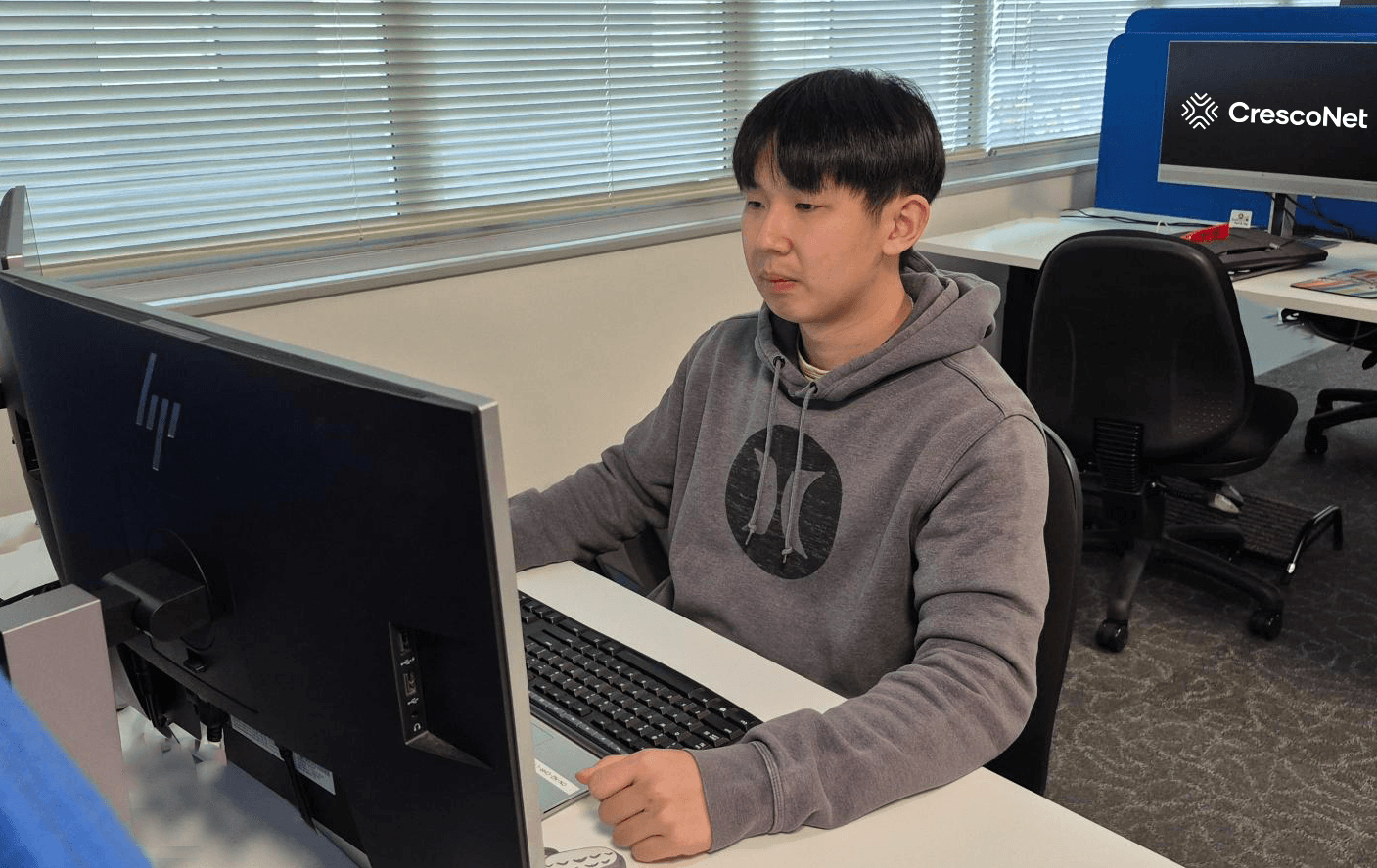
CrescoNet’s new Engineering Intern
In July, CrescoNet welcomed Abner Edgar to the team as an engineering intern. Abner is currently completing a Master of Engineering Studies (endorsed in Renewable Energy) at the University of Canterbury in Christchurch, where he is a recipient of the Orion Master’s Energy Scholarship, having earned his Bachelor of Engineering in Indonesia. He brings a genuine curiosity for how electrical and energy systems work, along with a growing passion for renewable energy. We sat down for a quick chat to hear about his journey from Indonesia to Christchurch, what drew him to CrescoNet, and what he gets up to when he isn’t deep in the technical detail.
You’re currently doing your Master of Engineering at the University of Canterbury. What first sparked your interest in engineering?
I’ve been interested in engineering since high school. I remember my aunt bought me an electronics module for kids. I could build series and parallel circuits and make a simple light bulb turn on, which I found fascinating. I also loved solving Rubik’s Cubes and working out how things fit together. My real turning point came in my third year of university: after three years of electrical engineering, everything suddenly clicked and I understood how technologies work from an engineering point of view. That deepened my interest and, with all the conversations around climate change, motivated me to pursue renewable energy for my master’s.
You were awarded the Orion Master’s Energy Scholarship, that’s really impressive. How did that come about, and where does your interest in energy come from?
It’s a competitive scholarship. You have to apply, and they only offer one each year, so I feel lucky to have received it. I think my academic background and my strong interest in the energy sector helped. As part of the application, I shared some personal projects and my thesis, which is a Maximum Power Point Tracking (MPPT) solar charge controller, this essentially means maximising the energy harvested from a solar panel and storing it in a battery. I’ve also done energy-modelling work, which reflects my interest in making energy systems more efficient and reliable. For the final part of the scholarship, we were asked to propose how we’d contribute to society. My idea was energy-generating floors in busy public spaces that are converting people’s footsteps into small amounts of energy that could be stored and used to power small systems.
What interested you about CrescoNet, and how did the internship come about?
I found CrescoNet through the University of Canterbury’s internship pipeline. I was keen to grow in an area where software, electrical and automation all meet, and once I read the internship description it felt perfect. CrescoNet sits right between the software side, the electrical side and real-world energy infrastructure. I was also struck by the scale: the team handles around 7.8 billion data points a day. I’ve never worked with that much data before, so I’m really keen to learn how a smart energy metering company manages it.
What are your plans and dreams for the future — what would you like to do once you’ve finished your master’s end of this year?
I think I’ve done enough studying for now! After I finish my master’s, I’d like to focus on the practical, industry side of things, ideally staying in renewable energy. Now that I’ve seen what CrescoNet is doing with smart energy systems, my hope is to perform well in the internship and find a great opportunity, to keep on learning and contributing in real life.
Tell us a little about your background and what you enjoy outside of work.
I grew up in Indonesia and came to New Zealand in July 2025, spending my first few months on holiday with my aunt. My sister is also here, studying at the University of Canterbury. I completed my electrical engineering degree in Indonesia before coming over for the renewable energy studies. I’ve always been interested in software too — I did an internship at Apple Academy in Indonesia, where I learned to build software within the Apple ecosystem and picked up Agile practices. I enjoy connecting the software and electrical sides of engineering, and I’ve worked with languages like Python, C and C++ alongside GitHub, on projects spanning IoT, power electronics, sensors and battery charging.
Outside of work I play badminton, and I love getting out hiking. There are so many beautiful spots around Christchurch, so I try to make the most of the beautiful landscapes and nature here.
Is there anything else you’d like to share?
Mostly, I’m just grateful for the opportunity. Only in my first week alone, I learned a huge amount that’s relevant to the industry — from the history of the sector and the regulatory bodies through to how energy systems are monitored and managed. Working closely with the team has taught me a lot about communication and given me a real understanding of how smart metering works in the real world. This includes how much higher-resolution data can help improve the systems compared with what was available before.
From building simple circuits as a child to working with billions of data points a day, Abner’s path has been driven by genuine curiosity and a real commitment to renewable energy. In just a short time he has already made a great impression, and we’re delighted to have him with us.
“Our UC partnership is a good deal for both sides. Students bring in new ideas and recent research. In return they get to work on live energy infrastructure see how smart metering runs at scale, which isn’t something you can pick up in a lecture”, says Ashley Johnston, Group CTO at CrescoNet.
The whole team wishes Abner all the best with the final stretch of his master’s. Welcome to the team, Abner!